CSR leaders at PlayCom 2025 stressed long-term investment, community ownership, and grassroots models as keys to sustainable sports development in India.
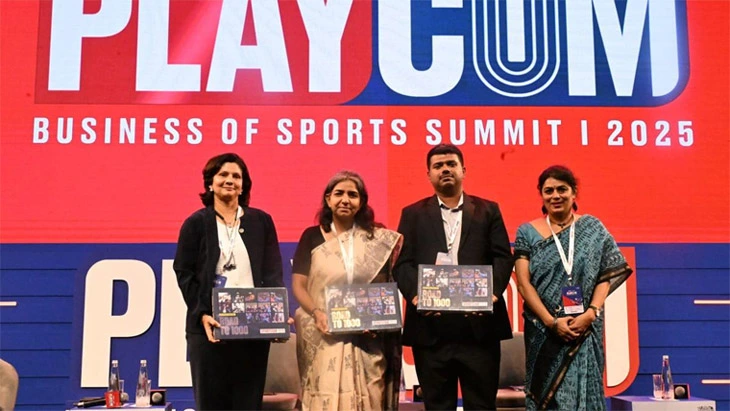 |
| Panellists at PlayCom 2025: Neelam Babardesai (Head of Sports, Tata Trusts), Anupam Nidhi (CSR Head, Vedanta & Hindustan Zinc), Prijoe Tharu (Associate General Manager, HCL Foundation), with moderator Chitra Narayanan (The Hindu Businessline). | Photo Credit: SUSHIL KUMAR VERMA |
Leadership that strongly supports corporate social responsibility (CSR) is crucial to building sustainable sports development programmes with lasting impact, said Anupam Nidhi, Head of CSR, Vedanta Group & Hindustan Zinc, at Sportstar’s PlayCom 2025 – Business of Sports Summit in New Delhi on Saturday.
“There are multiple ingredients needed to make a programme successful. If you have a leader at the top or a promoter who is invested in sports, it automatically gives you the boost and direction to stay committed. Sport is not an area where you can expect results in one, three or even four years. You have to stay invested for nine or 10 years to bring about real change and create a sustainable model,” Nidhi said during the panel titled ‘Purpose Play: CSR, Inclusion & Sport for All’.
But no CSR programme can be limited to only the development of players. “It is not just about the players themselves; a lot of them may not become active players. They may have to be looked at for other livelihoods as well. So you need to build them in a holistic manner,” Nidhi added.
Neelam Babardesai, Head of Sports at Tata Trusts, stressed that community-driven models can be self-sustaining and need not depend solely on corporate backing. Citing Tata Trust’s badminton initiative in Mizoram, she underlined that people must remain central to any programme.
“We piloted sustainability in Mizoram. We started with 40 grassroots centres across the State with community ownership. Mizoram has an amazing sports culture where everybody plays.
“So, we initiated community-owned grassroots centres and asked them to collect fees, allowing them to decide the amount. These centres were managed by the local communities. None of that money came to us — we only helped set up the structures and supported them for the first three years. We funded the coaches’ salaries, covered tournaments, shuttles and other essentials, and built the ecosystem around it.
“In 2021, when we could not fund the programme, we thought it might die down. But within six months, the community stepped up, using the money they had collected over the three years. They managed to sustain the centres through that eight to 10-month period without our support. Even today, about 25 to 26 grassroots centres across the state are able to run on their own,” Babardesai said.
Adding to the point of engaging at the grassroots, Prijoe Tharu, Associate General Manager, HCL Foundation, shared how his company broadened its base to enhance its programme.
“With ‘Sports For Change’, which we launched in 2017, we have been purely focused on grassroots development programmes, and the idea actually came from the students themselves. When we were running education programmes in schools, students asked us why we didn’t start something in sports for them. That is how it began — as a purely volunteer-led movement. Today, we have reached more than 65,000 students across 20 States, which is one of our biggest achievements.
“We also run something called the ‘Sports For Change’ competitions, exclusively for government school students, and these take place throughout the year. Last year, 12,000 students from 20 different States took part. From there we held district, state and zonal competitions. We also held a National Championship in Chennai with 800 students. We also offer Sports Scholarships to the national winners, the best performers, and we support them for a minimum of three to five years,” Tharu said.
Beyond laying a foundation at the bottom of the pyramid, Nidhi also stressed on the need for CSR ventures to expand their horizon to help more athletes.
“Inclusion is not a challenge but an area of improvement we are focusing on for the next five years. First, we want to bring more women into the sporting ecosystem by creating hubs and platforms where they can learn and exchange ideas across disciplines, whether it is football or archery. The second priority is para-athletics, where we have been investing even before last year’s Paralympic success, particularly through our initiatives in Rajasthan and beyond. The real task is to build infrastructure and, just as importantly, a strong resource pool of coaches. These are two areas that demand our attention,” she said.
But establishing grassroots programmes comes with the persistent problem of age fraud. On how to tackle the problem, Babardesai said: “Age fraud is an issue, especially at the junior level where we face it the most. It stems from incentives like prize money and job security, which are positive in themselves but also push athletes, players and coaches to make those small tweaks to win medals. A simple step could be registering a player’s birth certificate at their very first grassroots tournament, where there is no ambition or real competition. If that record is standardised and carried forward, it can then be passed along to federations as the players progress to higher levels.”
The article was first published on 13 September, 2025 on sportstar.thehindu.com
