A career in sport extends far beyond the playing field, encompassing diverse professional roles in coaching, science, and management that provide long-term stability.
 |
Across India's towns and villages, children take to playgrounds with the same simple joy - to run, kick a ball, swing a bat, or smash a shuttle. Yet for many families, especially in rural and tribal areas, that joy must answer a practical question - "Can this become a future profession, or is it just a hobby?" For most young people who grow up loving sport, the answer won't be found on the podium or on the playing field. It will be found in the dozens of roles that make sport possible - as coaches, physiotherapists, referees, analysts, nutritionists, event managers, and content creators. What's emerging now is a deeper understanding - that a life in sport doesn't have to end when the playing career does, and that the ecosystem needs as many skilled professionals off the field as it does athletes on it.
When the Mat Slipped Away
I know this truth from lived experience. At 15, a back injury ended my competitive gymnastics career. For 12 years, I didn't think I could have a career in sports. I completed my engineering, worked in IT, got married, and had children. I coached on the side because I couldn't quite let go, but I saw it as a passion, not a profession.
At 36, something shifted. I realised I didn't have to choose between my training in IT and my love for sport - I could bring them together. I used my coding skills to develop India's first gymnastics judging program, which was implemented at the 2006 Asian Gymnastics Championships. For the first time, I saw how professional qualifications could serve the game I loved - that was my turning point.
That programme led me back more deeply into gymnastics. I started my own coaching class, trained younger coaches, and created a curriculum with the aim of sharing the joy and potential of gymnastics with as many children as possible. Sports, I realised go far beyond competitions. They shape character, instill values, and leave people with life skills that endure long after the game ends.
From Field Lessons to Career Frameworks
Over the past decade, working across hockey, badminton and other sports in states like Jharkhand, Odisha, Assam and Mizoram, I have seen extraordinary talent flourish in the most unexpected places. What we need now are more pathways to help talent grow and sustain itself.
Many people traditionally view sporting careers through a narrow lens. They are unaware of the limitless landscape of possibilities - physiotherapy, events, marketing, content creation, etc. Exposure to these, and information on how to qualify for these or what they pay, is limited. While sporting ambition is high, guidance is scarce.
What is also important is understanding the skills that make these careers viable and how to strengthen this talent pipeline. Whether this means teaching confidence or communication and then translating skills into real chances - supporting visibility around concrete pathways to enter this ecosystem becomes critical. This can help young people not only dream of a future in sport but also understand how to build one.
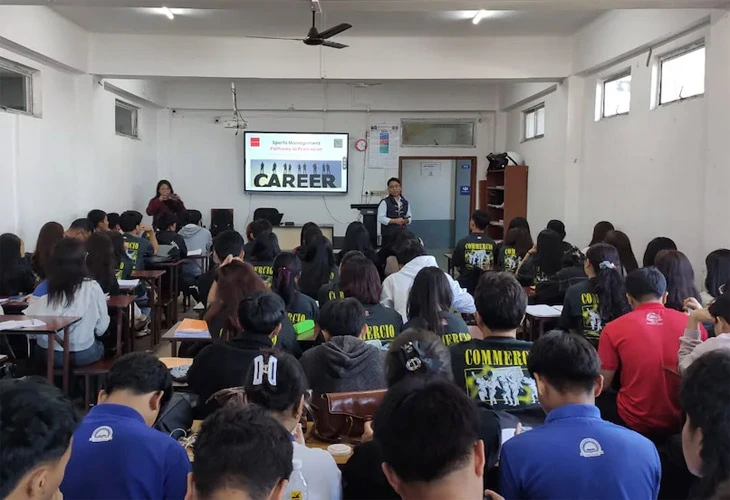
This realisation led the Tata Trusts to develop S.C.O.R.E (Sports Career Orientation, Readiness and Empowerment), a holistic framework to empower youth by helping them understand the full spectrum of professional career options available in sports, on and off the field.
What It Looks Like on the Ground
In Mizoram, where badminton is part of everyday life, the conversation is shifting. Since 2018, as programs have expanded to identify and support young players, youth from the community are building careers as coaches, referees, sports physiotherapists, and program managers. Playing careers may be limited by age, injury, and competition, but the love for sport doesn't have to be.
Community centres introduce children to sport. Those who show promise move to regional hubs for intensive training, and eventually to a planned residential centre combining coaching with education. Woven throughout is skills development - communication and first aid workshops for aspiring coaches, scholarships for those interested in sports science, financial literacy for players and digital literacy for future administrators. The pathway branches outward into dozens of roles that keep the ecosystem alive.
Building Together
At its heart, this approach can preserve the joy of play while expanding the possibility of profession. When a hockey player who misses the state team can see a future as a coach; a gymnast becomes a rehabilitation assistant; or a football enthusiast finds their place in sports media or management - sport becomes a steady, dignified pursuit.
Philanthropy is uniquely positioned to pilot innovative programs, testing what works and building evidence for scale. The real transformation happens when governments, federations, academies, and employers come together - integrating these frameworks into policy, creating pathways within existing structures, embedding skill-building alongside training, and recognising the diverse expertise that sport develops. When stakeholders work in partnerships, we can build something that creates lasting change.
To every young person who has ever felt that tug between passion and practicality - there is space for you here. Not just on the field, but in everything that keeps the world of sport alive. The way you love the game, the lessons you have learned, the grit you have built are the beginnings of something bigger. There is a place for you in sport, and together, we can make sure you find it.
— Neelam Babardesai, Head of Sports at Tata Trusts
This article was published on NDTV Sports on 23 March, 2026.
